Wednesday, July 16, 2014

Review of Cinema's Sinister Psychiatrists by Emma McGinty, Ph.D., M.S., American Journal of Psychiatry

Book Forum   |                        

Cinema’s Sinister Psychiatrists: From Caligari to Hannibal
by Sharon Packer., M.D. Jefferson, N.C., McFarland, 2012, 256 pp., $45.00.
Reviewed by Emma McGinty, Ph.D., M.S.
Am J Psychiatry 2014;171:472-473. doi:10.1176/appi.ajp.2013.13101403                                                           
Sharon Packer’s Cinema’s Sinister Psychiatrists takes readers on an exhaustively researched journey through the history of psychiatry on the silver screen. Packer’s work reviews cinematic depictions of mental health “professionals,” including Hannibal Lecter, Nurse Ratched, and a host of other cinema psychotherapists, hypnotists, asylum directors and the like, from the late 1800s through today.
 
Strikingly, in spite of considerable advances in the quality of mental health treatment over the past century, film depictions of psychiatrists have remained overwhelmingly negative over time.
 
Packer interweaves film history with psychiatric history, highlighting cinematic portrayals of psychiatrists who embodied critical issues faced by the field of psychiatry, such as deplorably run asylums and involuntary treatment, during various periods in the past century. A strong undercurrent in Packer’s book is the idea that while manifestations of “sinister” psychiatrists and other mental health professionals in film have fluctuated over time—from hypnotists to dream doctors to psychiatric nurses in the ilk of the infamous Nurse Ratched from One Flew Over the Cuckoo’s Nest—the tenor of these portrayals has remained largely unchanged. Perhaps the quintessential sinister psychiatrist discussed by Packer is Dr. Hannibal Lecter, the star of five films to date, including Hannibal and Silence of the Lambs. The films portray Dr. Lecter as a psychiatrist who severely mistreats his patients, for example, by using a combination of drugs and hypnosis to convince his patient in Hannibal (a pedophile receiving court-ordered treatment) to cut off his face and feed the flesh to the dogs. If this weren’t sinister enough, Hannibal Lecter is also a cannibal, admittedly one of the more extreme dramatic devices used to characterize a sinister psychiatrist. In spite of large increases in the number of Americans seeking mental health treatment in past decades (1), even recent films such as Batman Begins and Changeling tend to portray sinister psychiatrists who bear little resemblance to the mental health professionals seen by nearly 20% of Americans each year (2).
 Today, do film portrayals of sinister psychiatrists simply serve as good dramatic devices, integral to movie plots? Or, as some have asserted, do negative depictions of screen psychiatrists reinforce stigma and make those with mental illness reluctant to seek treatment (3)? Communications research has shown that media depictions of specific individuals can influence public attitudes about entire groups of people (4), giving theoretical basis to the idea that film portrayals of sinister psychiatrists may lead to public mistrust of mental health professionals. There is also reason to reject, as Packer does, the idea that film portrayals of manipulative, frightening, or even diabolic psychiatrists are an important driver of attitudes about mental health treatment. One in five Americans sees a mental health professional each year (2), and most of us have a friend or family member who has been treated for mental illness (1). Experience with mental health treatment—our own or someone else’s—likely has a much stronger influence on Americans’ attitudes toward psychiatry than cinematic portrayals of psychiatrists.
 
For Packer, screen psychiatrists are not created from imagination alone. Rather, film psychiatrists reflect the public’s ideas, fears, and hopes about the field of psychiatry. Packer describes a period in the late 1950s and early 1960s—a period she terms the “Golden Age” for cinema psychiatrists—when a spate of films portrayed psychiatrists as compassionate and unrealistically omniscient. The 1957 film The Three Faces of Eve, which Packer calls the “poster film” for the Golden Age of Psychiatry, portrays a psychiatrist named Dr. Luther, who successfully treats a housewife (Eve) with multiple personality disorder. The film paints a rosy picture of Dr. Luther’s treatment of Eve, who comes into his care after being abandoned by her husband and trying to kill her daughter. While she initially presents with two personalities—Eve White, a humble housewife, and Eve Black, a wild, party-going alter-ego—Dr. Luther’s treatment prompts a third, stable personality to emerge. At the end of the film, Eve (now called Jane, the name of the stable personality) remarries and reunites with her daughter. Typical of Golden Age films, Dr. Luther’s treatment of Eve was portrayed as effective and final. In contrast, the real-life woman the film was based on, Chris Costner Sizemore, reported exhibiting additional personalities and requiring ongoing treatment from multiple psychiatrists after her initial “cure.” In contrast to their demonized counterparts in the majority of films Packer reviewed, Golden Age film psychiatrists were idealized and imbued with healing powers far beyond the available treatments of the day. Packer credits this Golden Age of screen psychiatry to societal enthusiasm about the major medical successes of the 1950s, including development of the polio vaccine. When chlorpromazine was introduced in the United States in 1954, it seemed possible that mental illness, like polio, would soon be eliminated by benevolent, and heroic, doctors.
 
This is a book about how cinematic depictions of psychiatrists, dramatic devices though they are, reflect society’s views of psychiatry. In Packer’s view, we have the most to learn from cinematic portrayals of sinister psychiatrists, opposed to the short-lived idyllic portrayals of the late 1950s. For her, “if we want to understand society’s reaction to psychiatry, we need to examine the most common media representations (or misrepresentations) rather than the comparatively rare idyllic portrayals” (p. 5).
 
Part expansive film review, part detailed history of psychiatry; I recommend this book for film buffs and mental health practitioners alike.

Sunday, July 14, 2013

White House Down (Emmerich, 2013) SPOILER ALERT

White House Down is one of a string of action-adventure films that revolve about an imperiled US. It is a post-911 ode to anxiety. It is also a family drama, where a clever but pouty teen-aged girl comes to the rescue. She saves the show and reconciles with her errant father, who saves the other side of the show. The recently divorced father has a chance to show his best side, after a number of bungles at the beginning.

Channing Tatum saves face. He even saves the President (Jamie Foxx) and a White House full of hostages, including his daughter--after he being rejected by the Secret Service and after failing to meet his fatherly responsibilities.

There are plenty of shoot-‘em-up scenes, with fighter planes and military helicopters looming overhead and rocket launches from the White House roof. Hand-to-hand combat occurs often. All this should have been enough to satisfy the action-adventure audience. Yet the film flopped at the box office, possibly because it tried to be all things to all people (family fun plus political intrigue plus action-adventure). This “jack of all trades” wound up being “a master of none.”
Still, the film was fun, even if the story line has grown familiar by now.  Central to the film is the paramilitary group that plans to take over the White House, and almost succeeds. The sell-out insider (James Woods) who leaks secrets is also a recurring stereotype, even though we never suspect silver-haired Secret Service Agent Walker as he cuts the cake at his retirement party.

Interestingly, James Woods starred in Videodrome (Renn, 1983), a bizarre film about a man with a brain tumor who hears his TV talk. In the film, the protagonist insists that the hallucinations caused the tumor, rather than the other way around.
When we learn that James Woods’ character in White House Down also suffers from a brain tumor—a frontal lobe tumor, specifically—we are not too shocked. No, I correct myself: those of us who know something about neuropsychiatry or behavioral neurology are shocked that the film’s medical advisors let this one pass. Frontal lobe syndromes cause apathy and amotivation and strip the sufferer of the ability to strategize. James Woods plans, plots and strategizes, even though his efforts are misdirected. Had the film claimed that he had a temporal lobe tumor that changed his behavior and made him moody and impulsive, I might have been more impressed. If it located the tumor in the amygdala, or in the rage center of the brain, it would be even better.

Temporal lobe disease can also induce “déjà vu”—a sense of familiarity or a feeling that a current event previously occurred in the past. For I had a sense of déjà vu while watching the denouement. The movie reminded me of the Iran Contra scandal from the 1980s, when then-CIA director William Casey helped to secure arms for Nicaraguan rebels (after Congress forbade such acts). Casey himself developed a brain tumor (definitively diagnosed as a lymphoma after his death). He suffered two seizures the day before he was to testify to a Senate panel about the Central Intelligence Agency's role in the sale of American arms to Iran.

The moral of the story?
This improbable paranoid plot is based on a kernel of truth. For that, I can forgive the filmmaker for an anatomical error about the location of a fictional brain tumor.

Sunday, June 16, 2013

The Great Gatsby (Luhrmann, 2013)

What do Iron Man 3 and The Great Gatsby have in common?

No, this isn't one of those kindergarten jokes--this is for real. Even though their plotlines and the cinematography couldn't be farther apart, these two films share their psychoanalytic framing device. In Iron Man 3, the psychoanalytic session/framing device is the reveal. It appears in the epilogue.

In The Great Gatsby, we meet Nick Carraway in a sanitarium, before the action starts. Carroway narrates the novel and speaks in Fitzgerald's voice. F. Scott Fitzgerald does not include a sanitarium scene in his original Gatsby, although sanitariums are prominent in other stories, and surely figure into the sad tale of his wife, Zelda, who herself went in and out of mental hospitals.

Iron Man 3 (2013)


By Memorial Day 2013, Iron Man 3 (Black, 2013) was poised to break box office records. In little more than three weeks’ time, receipts reached the billion dollar mark. Impressive, even for superhero cinema. Why did this film perform so well? Let’s toss around some theories.   

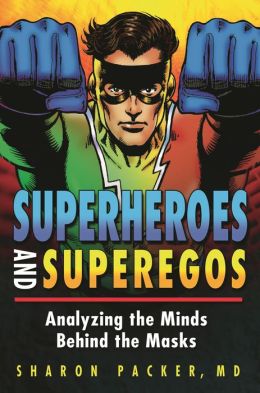
Superheroes and Superegos: Analyzing the Minds Behind the MasksThe draw of the Sir Ben Kingsley as the drug-addled “Mandarin” double needs no extra explanation. Kingsley was knighted for his acting abilities long before accepting this role as a behind-the-scenes surrogate for the real powerbroker played by Guy Pearce.   Stark seeks retribution--before he rebuilds his cliffside home. He forgot that he rebuffed the once down-and-out scientist (Guy Pearce) who has resurfaced and is now is planning to overtake America and reshape the world as we know it.
 
The terrorist theme, the superhero story, even Stark’s back story as a tech genius turned philanthropist, and a successfully recovering alcoholic to boot, speak to the times. 

Add state-of-the-art special effect, class-A cinematography, and a fast-paced script with action, adventure, romance, and redemption to the mix, and a blockbuster is born.  Star power adds allure, but Sir Ben Kingsley is not the star, even though he is a shining light.

First of all, the film stars Robert Downey, Jr. Robert Downey, Jr.’s portrayal of Tony Stark is perennially appealing. Downey’s personal drug history, and his well-publicized and repeated struggles with rehab, animate his acting and makes Stark’s ex-alcoholic character scintillate. Guy Pearce, the villain, and Gwyneth Paltrow, as Pepper Potts, have more than their fair share of fans. Iron Man 3  reassures Americans of success that awaits them, yet it also reflects mounting fears about foes that lie in wait. It implies that deadly enemies may masquerade as unemployed actors (Ben Kingsley), suicidal scientists (Guy Pearce), or other superficially benign beings, such as the beautiful botanist (Rebecca Hall) who changes alliances after creating the Extremis virus that drives the plot. Those themes alone should be sufficient to attract audiences, as it simultaneously stokes and allays anxieties about contemporary world events. The movie’s motifs replay recurring conflicts between science and creationism, and humans against the machine. On a psychological level, it showcases the challenges of changing fate and facing fear versus accepting the status quo. 

The film includes a subscript to that is not readily apparent to the average spectator, but is highly relevant to my forthcoming book about neuroscience in science fiction film, which addresses and the place of neuroscience in post-psychoanalytic society. Better than any other film that I have seen to date, Iron Man 3 captures the spirit behind this book,  because it alludes to the “two minds” of psychiatry that stand at loggerheads, today as much as ever. It references both biological psychiatry, now known as “neuropsychiatry,” and the “couch cure” of psychoanalytic lore.  

If we listen to the dialogue between Stark and Banner (Mark Ruffalo), with our ordinary hearing and with our third ears, we can hear commentaries about the theoretical and practical rift in psychiatry. As the epilogue in Iron Man 3 opens, the camera moves in, showing a close-up of Tony Stark. Tony is thanking “Bruce” for listening and for letting him “get it off his chest.”
 
Read More in my forthcoming book about Neuroscience in Science Fiction Film (McFarland)


Tuesday, February 12, 2013

Side Effects (2012)

Director Steven Sonderbergh has more than his fair share of fans .  Those fans will see similarities in subject matter between his first feature film sex, lies & videotape (1989) and this film. Many  fans will hope to find more similarities between his more recent film Contagion (2011) and this film, especially since both concern corrupt medical systems or officials and frightening public health hazards.

Sadly, Side Effects does not grip the spectator as Contagion does, even though its script struggles to make dramatic twists and turns and adds an interesting website. www.sideeffectsmayvary.com

Some details are realistic: drug company logos on pens, clandestine offers to pay Jude Law’s psychiatrist character $50,000 to test new meds on his patients, psychiatrist Catherine Zeta-Jones’ not-so-subtle push about new products, pharma-sponsored educational conferences, Jude Law asking for Adderall.  They all smack of the truth, sad to say. However, those who know Hitchcock immediately recognize near-mirror image repeats of the movie master’s framing shots, plot-driving devices, even damning character flaws. For them, there will be no suspense. Yet this movie is intended to be suspenseful.

Side Effects succeeds in opening questions about contemporary psychiatric practices. Yet so much of the plot is so far-fetched that even though salient details may be lost on those who dismiss everything about Side Effects as pure fantasy. Still, Side Effects captures contemporary  2012 Manhattan psychiatrist stereotypes well—or at least as well as De Palma’s Dressed to Kill (1980) captured skyscraper psychiatry did over thirty years ago.
Like Sonderbergh’s Side Effects, De Palma’s Dressed to Kill also replicated Hitchcock’s tour de force in Psycho (1960). Like De Palma, Sonderbergh exploits unexpected sexual preferences to the max, but 2012 is not 1980. Shock value has simmered.
For many more examples of sinister psychiatrists in cinema, please  see Cinema’s Sinister Psychiatrists (McFarland, 2012).
www.drsharonpacker.com 
 

Sunday, January 13, 2013

It's a Wonderful Life (1945)


The holiday season has passed. Now we can gleefully look back at the “myth of the holiday blues,” to  see where that myth started. In an article that I wrote for the December 2012 issue of SoHo Life magazine (“Beating the Holiday Blues”), I speculate that a specific movie inspired that myth. That movie led us to believe that the December holiday season brings sadness and even suicide, when, in fact, suicides drop to their lowest levels in December, and are lower in this month than any other. Unfortunately, news articles have perpetuated that myth, as documented by the CDC website.
Which movie prompted such misinformation? It was Frank Capra’s classic It’s a Wonderful Life (1945), starring Jimmy Stewart. This wonderful movie shows a hapless man, drunk and depressed, teetering on the brink, ready to end it all on Christmas Eve. Then an angel appears, and shows him how the world was a different, better place--because of the lives he touched.
Stewart’s acrophobic character in Hitchcock’s Vertigo (1958) becomes all the more credible because of his unforgettable performance as a deeply disturbed man in the Capra classic.
Jimmy Stewart (1958) 
Just because the film exercises dramatic license, and includes misinformation, doesn’t mean that it isn’t a most wonderful film.
After all, there’s a reason this film replays each Xmas season.

Monday, November 19, 2012

Conspiracy Theory (1997)

Conspiracy Theory (1997) Dir: Richard Donner

Laurence Olivier as The White Angel,
hovering over hapless Dustin Hoffman,
in Marathon Man (1976).

Why would I mention a nearly forgotten 1997 film now? One would think that I would be disinclined to mention movies that star Mel Gilson. For Mel Gibson has since been reviled for his racist and anti-Semitic rants in real life, even though he was applauded for his similarly psychotic, off-the-cuff incantations when he plays an incoherent cab driver who was duped by the CIA and doped with LSD by “The Company” doctor.


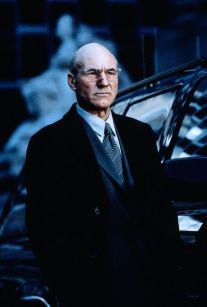
The film shifts between an action-adventure motif to a romantic comedy subplot. We learn that Gibson’s paranoid character was used as a test subject in  earlier CIA’s secret experiments. This time around, Dr. Jonas, a CIA psychiatrist, captures him and binds him to a wheelchair, and tapes his eyes open. Patrick Stewart, better known for Star Trek and later Professor X roles, plays Dr. Jonas.

Gibson’s misfortunes clearly began before meeting Julia Roberts, who plays an attractive young attorney who is on a quest to learn the who’s and why’s of her father’s mysterious death. Infatuated with Julia Roberts, Mel Gibson stalks her in a laughable rather than predatory way. He eventually wins her heart after his Conspiracy Theory proves true. 

Again, let me ask (myself) why I would mention this film now? The answer is obvious, for those of you who read the last post on The Bourne Legacy (2012), where I discuss genetic experiments conducted on another covert operative, played by Jeremy Renner.  In that case, an indifferent doctor (Rachel Weisz) administers experimental injections that enhance performance. Weisz is not malevolent; she is simply detached and does not know the name of her patient, even after four years have passed.  In addition, Weisz is a virologist and is not a psychiatrist, although her treatments change Renner’s behavior, enhance his cognition (and maybe make him addicted).

Some readers may know of the CIA’s MK-ULTRA project, where tests subjects were dosed with LSD and subjected to behavioral conditioning studies, not by fringe elements of the profession, but by a psychiatrist who once headed both the American Psychiatric Association and the Canadian Psychiatric Association. Other academic centers participated in these occasionally lethal tests, sometimes unwittingly. Andrea Tone wrote an award-winning book on the topic.

In Conspiracy Theory, Patrick Stewart’s hairless and smile-less psychiatrist is as sinister as could be. He is so sinister that he reminds us of Laurence Olivier’s rendition of the Nazi dentist known as White Angel. In that classic under-the-Brooklyn Bridge scene in Marathon Man (1976), Laurence Oliver drills into Dustin Hoffman’s teeth to force him to reveal his brother’s secrets.
Like Patrick Stewart’s Dr. Jonas, Marathon Man’s evil DDS consorts with American agents. Dr. Jonas is so sinister that he could span an entire chapter in my recent book on Cinema’s Sinister Psychiatrists (McFarland, 2012). He might have done just that, except for the fact that there are many more intriguing examples of conspiracy theories and sinister psychiatrists in the chapter.

To read more about Marathan Man's references to the McCarthy Era, and learn how those troubled times translated into paranoid themes in film, pl see Movies and the Modern Psyche (2007).


McFarland Catalogue